The penannular brooch, and the Roman fibula, provide a simple and efficient mechanism for fastening loosely woven cloth. They began as utilitarian fasteners in the Iron Age and Roman period and evolved into highly ornate brooches (e.g. Celtic Brooches) by the early Middle Ages.
Penannular brooches, and fibuli (the plural of fibula), all have the same basic construction. They feature a long pin attached by its head to an open ring. The pin can move freely around the ring as far as the ends. The ends of the ring, which have to be large enough to prevent the pin from falling off, are typically decorated. There is a gap between the ends of the wide enough for the pin to pass through.
Fastening a penannular brooch is a three-step process:
- With the ring of the brooch upside down, push the pin of the brooch through all layers of the garment (cloak, scarf, shawl, etc.) you wish to fasten.
- Flip the ring portion of the brooch over, so that the gap of the ring is aligned with the pin.
- Bring the end of the pin through the gap and above the end of the brooch, then rotate the ring until the end of the pin moves past the end. The garment is now secure.
I have been making penannular brooches/fibuli for more then 30 years. I started making them when I was living in Massachusetts and active in the SCA. At that time, very few period (medieval) fasteners for garments were available and what few were available were expensive and more intended to be decorative than functional. I decided to change that and began making and selling fibuli, some priced as low as $0.50, and all designed to be rugged enough to be used.
All of the penannular brooches I make have the same basic construction. I bend a length of brazing rod around a mandrel and then cut the circles apart. If the brooch is to have looped ends, I cut more than a complete turn each, if the brooch is to have decorations attached to the ends, I cut slightly less than a complete turn each. The pins for the brooch are made either out of brazing rod (typically a smaller gage then the circle), or by cutting apart large safety pins.
Once the components of the brooch are made and polished, I assemble the pins using a wide variety of materials for the end decorations.

How To Use A Penannular Brooch
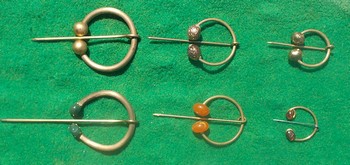
Assorted Penannular Brooches
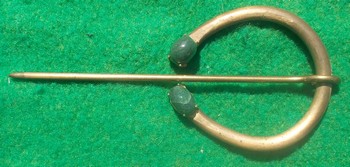
Closeup of a Large Penannular Brooch
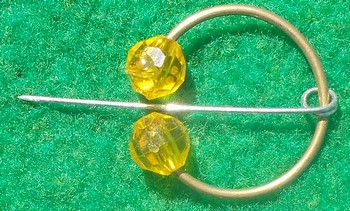
Closeup of a Small Penannular Brooch