There are certain books that I consider essenial reading. I am sure that you will disagree with some, or all of my choices and I would love to hear which books you would like added/removed, as well as the reasoning for the additions/removals.
I have only included books in that section that I believe provide information is useful for everyone, not books that are only of value with specific professions or hobbies.
Niccolò Machiavelli
1532
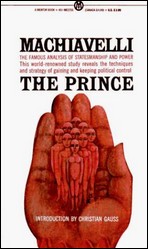
If you really want to understand why revolutions susceed or fail, this book written by a 16th Century Italian diplomat can provide the answers. While in collage (late 1960's), several friends and I would would apply the principals from the book to the many South and Central revolutions that we so common at the time. The book never failed to predict if the revolution would susceed and, if it susceeded, how the new government would last before the next successful revolution.
The Prince is sometimes claimed to be one of the first works of modern philosophy, especially modern political philosophy, in which practical effect is taken to be more important than any abstract ideal. Its world view came in direct conflict with the dominant Catholic and scholastic doctrines of the time, particularly those on politics and ethics.
This short treatise is the most remembered of Machiavelli's works, and the most responsible for the later pejorative use of the word "Machiavellian". It even contributed to the modern negative connotations of the words "politics" and "politician" in Western countries.
Sun-tzu
5th century BC
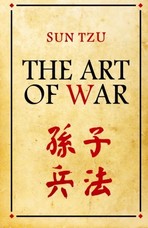
The Art of War is the Swiss army knife of military theory that has also become a source of inspiration in business, politics, and sports. Folded into this small package are compact views on resourcefulness, momentum, cunning, the profit motive, flexibility, integrity, secrecy, speed, positioning, surprise, deception, manipulation, responsibility, and practicality.
Most passages in the book are the pinnacle of succinct clarity: "Lure them in with the prospect of gain, take them by confusion" or "Invincibility is in oneself, vulnerability is in the opponent." Sun-tzu's maxims are widely applicable beyond the military because they speak directly to the exigencies of survival. Your new tools will serve you well, but don't flaunt them. Remember Sun-tzu's advice: "Though effective, appear to be ineffective."
Miyamoto Musashi
1643
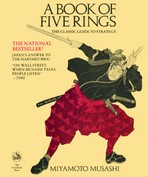
In The Book of Five Rings, one of Japan’s most famous Samurai warriors, Miyamoto Musashi, shares his principles for any aspiring warrior wishing to know the true Way of Japanese swordsmanship. Musashi claims that those who know the true Way are invincible in combat, arguing that it is strategy and discipline, not brute strength or innate ability, that make a successful warrior. Although a product of 17th-century Samurai culture, many of Musashi’s key principles can still be used by the modern reader in their personal and professional lives.
The Book of Five Rings is divided into five "books" or chapters, each named after a different natural element important in Buddhism:
Eric Hoffer
1951
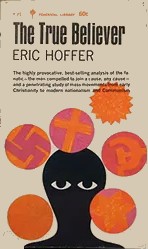
The True Believer is a non-fiction book authored by the American social philosopher Eric Hoffer. It explains why mass movements arise and why certain types of people are attracted to them. Hoffer discusses the sense of individual identity and the holding to particular ideals that can lead to extremism and fanaticism among both leaders and followers.
Hoffer explains the motives of the various types of personalities that give rise to mass movements in the first place and why certain efforts succeed while many others fail. He goes on to articulate a cyclical view of history such that why and how said movements start, progress and end is explored. Whether intended to be cultural, ideological, religious, political, or whatever else, Hoffer argues that mass movements are broadly interchangeable even when their stated goals or values differ dramatically.This makes sense given the frequent similarities between them in terms of the psychological influences on its adherents. Thus, many will often flip from one movement to another, Hoffer asserts, and the often shared motivations for participation entail practical effects.
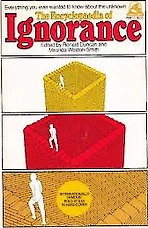
Ronald Duncan
1977
In this book, the world’s most eminent scientists, among them several Nobel Laureates, explore the infinite region beyond the edge of present knowledge. In simple language, authorities in fields as diverse as space, mathematics, physics and biology address those questions most vital to the human future.
A key point of the book is that the more you know, the more you know that you do not know. This may seem to be a contradiction in terms, but think of knowledge like a balloon. The only thing you can know that you don't know are the thing that touch the skin of the balloon. The more you inflate (add knowledge) the more the skin of the balloon streches and the more "things" with which the skin comes in contact.
The fiction books I have included here are ones that I believe are either culturally, technologically, or politically significant. Some are also very enjoyable to read, but that was not a significant factor in selection.
Please note that I have not included any plays, I agree with William Shakespeare that scripts should only be read by actors and the general population should watch the play being performed.
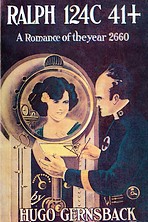
Hugo Gernsback
1911 (as a serial, compiled into book form in 1925)
Ralph124c41+ may be one of the worst written Science Fiction novels of all times. However, it is definately one of the most visionary. In the book Gernsback describes:
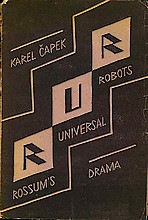
Karel Čapek
1921
Most people who know Science Fiction associate robots in with Isaac Asimov. But Asimov wast not the first to write stories about robots. His most important contribution to robots are his three laws1 which existed to prevent the scenario described in R.U.R. from happening.
R.U.R. is a science fiction play by the Czech writer Karel Čapek. I have included it in this list in violation of my usual rule not to include because the chance of actually seeing it proformed is virtually zero and it is to important to be forgotten. R.U.R. stands for Rossumovi Univerzální Roboti. The play introduced the word "robot" to the English language and to science fiction as a whole.
In R.U.R., Čapek imagines a future world where robots become the world’s workers, laboring for humans. He uses the robots' revolt and eventual annihilation of the human race to explore what it means to be human and the purpose of human life. The working conditions of Rossum's factory offer an opportunity to explore power dynamics created by labor and the dangers of robots.
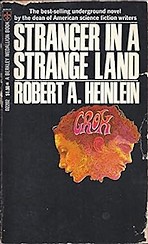
Robert A. Heinlein
1961
This book truely embodies the nature of the 1960's and the hippie movement. Originally titled The Heretic, the book was written in part as a deliberate attempt to challenge social norms. In the course of the story, Heinlein uses the book's main character (Valentine Michael Smith) open-mindedness to re-evaluate such institutions as religion, money, monogamy, and the fear of death. Heinlein completed writing it ten years after he had plotted it out in detail. He later wrote, "I had been in no hurry to finish it, as that story could not be published commercially until the public mores changed. I could see them changing and it turned out that I had timed it right."
Heinlein was surprised that some readers thought the book described how he believed society should be organized, explaining: "I was not giving answers. I was trying to shake the reader loose from some preconceptions and induce him to think for himself, along new and fresh lines. In consequence, each reader gets something different out of that book because he himself supplies the answers ... It is an invitation to think – not to believe."
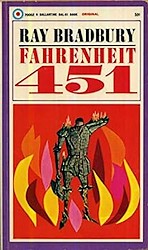
Ray Bradbury
1953
Fahrenheit 451 is a dystopian novel thay presents a future American society where books have been outlawed and "firemen" burn any that are found. Upon its release, Fahrenheit 451 was a critical success, albeit with notable outliers. The novel's subject matter led to its censorship in apartheid South Africa and various schools in the United States.
The novel follows in the viewpoint of Guy Montag, a fireman who soon becomes disillusioned with his role of censoring literature and destroying knowledge, eventually quitting his job and committing himself to the preservation of literary and cultural writings.
Fahrenheit 451 was written by Bradbury during the Second Red Scare and the McCarthy era. It was also inspired by the book burnings in Nazi Germany and by ideological repression in the Soviet Union. I think it is especially applicable today considering the Republican war against books that they think are "inappropriate".
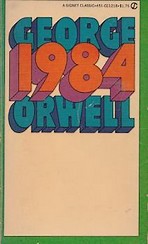
George Orwell
1949
1984 is a dystopian novel and cautionary tale by English writer George Orwell. It centers on the consequences of totalitarianism, mass surveillance, and repressive regimentation of people and behaviours within society. Orwell, a staunch believer in democratic socialism and member of the anti-Stalinist Left, modelled the Britain under authoritarian socialism in the novel on the Soviet Union in the era of Stalinism and on the very similar practices of both censorship and propaganda in Nazi Germany. More broadly, the novel examines the role of truth and facts within societies and the ways in which they can be manipulated.
The story takes place in an imagined future. Much of the world is in perpetual war. Great Britain, now known as Airstrip One, has become a province of the totalitarian superstate Oceania, which is led by Big Brother, a dictatorial leader supported by an intense cult of personality manufactured by the Party's Thought Police. The Party engages in omnipresent government surveillance and, through the Ministry of Truth, historical negationism and constant propaganda to persecute individuality and independent thinking.
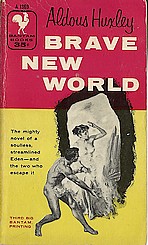
Aldous Huxley
1932
Brave New World is a dystopian novel by English author Aldous Huxley. Though not as dark as 1984 is also paints a disturbing picture of a possible future. The novel also accurately predicts many advances in technology. Largely set in a futuristic World State, whose citizens are environmentally engineered into an intelligence-based social hierarchy, the novel anticipates huge scientific advancements in mood altering drugs, reproductive technology, sleep-learning, psychological manipulation and classical conditioning. Many of these advances have already come to pass and society seems to be moving toward Huxley's "Brave New World".
Huxley used the setting and characters in his science fiction novel to express widely felt anxieties, particularly the fear of losing individual identity in the fast-paced world of the future. An early trip to the United States gave Brave New World much of its character. Huxley was outraged by the culture of youth, commercial cheeriness, sexual promiscuity and the inward-looking nature of many Americans
[1] Isaac Asimov's Three Laws of Robotics are a set of guidelines for how robots should behave, and were first published in his 1942 short story Runaround (20 years after R.U.R.). The laws are intended to prevent robots from harming humans, and have since become influential in science fiction and discussions about technology and artificial intelligence: