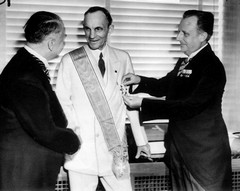
Most people today know Henry Ford only as the founder of Ford Motor Company. But there a also a very dark side of Henry Ford that should also be remembered. Henry Ford was one of Hitler's key American friends: in the years before the war and shared Hitler's views on the Jews. Ford worked with Germany to assure that its military preparedness before World War II. In a letter written in 1924, Heinrich Himmler described Ford as “one of our most valuable, important, and witty fighters”. Henry Ford's assistance in the German's preperation for war was so significan that he receiving the Grand Cross of the German Eagle from Nazi officials in 1938.
Ford is the only American mentioned favorably by Adolf Hitler in Mein Kampf. He wrote “only a single great man, Ford, [who], to [the Jews’] fury, still maintains full independence…[from] the controlling masters of the producers in a nation of one hundred and twenty millions”. Speaking in 1931 to a Detroit News reporter, Hitler said he regarded Ford as his “inspiration”, explaining his reason for keeping Ford’s life-size portrait next to his desk.
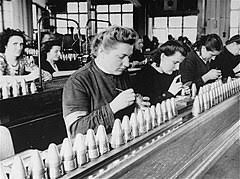
Max Wallace, a journalist and Holocaust researcher, says in The American Axis: Henry Ford, Charles Lindbergh and the Rise of the Third Reich that both men fell for Nazi propaganda. Wallace states in the book that the Ford Motor Company knowingly allowed slave labour at its German subsidiary during the Second World War and backed its European divisions making equipment for the Nazi military. Before America entered the war Ford supplied Germany with military equipment, while declining to make engines for the RAF, calling into question Ford's claims to have been "strictly neutral", says Mr Wallace. Simon Reich, a professor at the University of Pittsburgh who was employed by Ford to investigate the activities of the company's German arm under the Nazis, said of Mr Wallace: "He is reminding a new generation of who Henry Ford was and what he did."
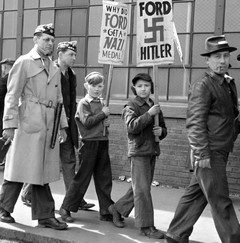
Referring to newly declassified government documents, Mr Wallace alleges that Nazi links at the Detroit company went well beyond Henry Ford. The documents indicate that his son Edsel, the then company president, could have been prosecuted for trading with the enemy had he not died in 1943. The evidence included 11 letters between Edsel and the head of Ford's French division in 1942 which suggest that the parent company knew and approved of the manufacturing efforts being undertaken on behalf of the German military. The Justice Department concluded that there was "a basis for a case" Edsel Ford.
Ford argues that it had no control over the use of slave labour at its German plant, as it lost control of the company after 1941. But documents cited in the book say the first forced labourers arrived at the factory before America entered the war. Intelligence documents also suggest that Henry Ford's secretary, Ernest Liebold, was a Nazi spy who helped develop his boss's paranoia about Jews.
For more information please see: