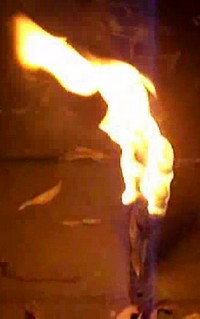
Back in 1979 I published these directions on how to make Rush Lights in Volumn 1 Number 2 of my Household's newsletter, "Tyme Tracks" (same issue as the article on Brewing Mead). I used these torches at the the Quests (LARPs - Live Action Role Playing) held at Tymekeep and at the Pennsic War (a week long annual event of the SCA).
Rush lights are simple, cheap, and very period (medieval). They burn for 15 to 30 minutes each and are a source of realistic lighting for a medieval encampment.
To make rush light you need dry cat tails and beef fat (tallow). You will need about a cup of fat per light. You will also need a tall thin container that is deep enough to cover the heads of the catails and some cloth (unbleached muslin works well) to filter the fat. The container should be metal and capable of being set on the stove or a hot plate to help keep the fat hot while it soaks into the cattail heads (I used an empty 48 oz. juice can).
Pick the cattails in the fall when they are full and brown but before they fluff out. After picking, dry them for a week or two to get the last of the moisture out of them.
Cut the fat into ½′ thick slices. Render it in a deep skillet over low heat. This is a continuous process with the cracklings being removed and more tallow being added as the fat renders.
Set the container on the stove or hot plate and set the heat to very low. Beef fat melts at 104 °F so you need to keep the container temperature above that but not so hot that you will damage the cattails. Put as many cattail heads as fit without crowding in the container and add hot fat, filtered thru a cloth, until the heads of the cattails are fully submerged. When the cattails stop bubbling, they are saturated with fat and can be removed from the container and set aside to cool. Add more cattails to the contained and as much additional hot fat as is needed to cover the heads. Repeat until all the cattails and fat are used.