Deuteronomy 6:4 (the Sh'ma) captures the core beliefs of Jewism. and, by extension, the foundation on which Christianity was built.
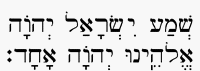
|
Sh'ma yis-ro-ayl, adonay |
Hear, O Israel, the Lord is our God, the Lord is one. |
The English translation, like any other translation of a sentence that has a complex nuance meaning, fails to capture the full meaning of the verse. To more fully understand the Sh'ma, one needs to look deeper into the meaning of each of the words.

|
Sh'ma |
A declaration of absolute belief. Something that onr knows, with every fiber of ones being, is true. |

|
yis-ro-ayl |
The people Israel, the entire Jewish nation, not the modern country of Israel. |

|
adonay |
God, the God that we worship. |

|
elo-hey-nu |
An acknowledgement of absolute sovereignty. |
|
|
adonay |
God, the God that we worship. |

|
ehod |
Singular and indivisible. |
This is the essence of the Jewish faith, the faith that Jesus taught as a Rabbi. In Mark 12:28, Jesus is asked "Which is the first commandment of all?" Jesus answers (Mark 12:29) "Hear, O Israel, the Lord is our God, the Lord is one."
Deuteronomy 6:5 then describes the relationship that man should heve with God: "And you shall love the LORD your God with all your heart, and with all your soul, and with all your might."
In Mathew 22:36, when Jesus is asked "which is the greatest commandment in the law?", Jesus responds by quoting this exact verse (see Mathew 22:37).
Deuteronomy 6:6-9 then completes the thought: "And these words, which I command you this day, shall be in your heart. And thou shalt teach them diligently unto thy children, and shalt talk of them when thou sittest in thine house, and when thou walkest by the way, and when thou liest down, and when thou risest up. And thou shalt bind them for a sign upon thine hand, and they shall be as frontlets between thine eyes. And thou shalt write them upon the posts of thy house, and on thy gates."
These verses express the responsibilities associated with the previous verses (Deuteronomy 6:4-5). You must:
- Keep them in your heart,
- Teach them to your children,
- Think of them as you carry out the business of your daily life,
- They should be close to your head, so you think about them when you are doing mental work, and close to your hands, so you think about them when you are doing physical work,
- They should be marked on your doors and gates so that you remember them when you enter and leave your house.